
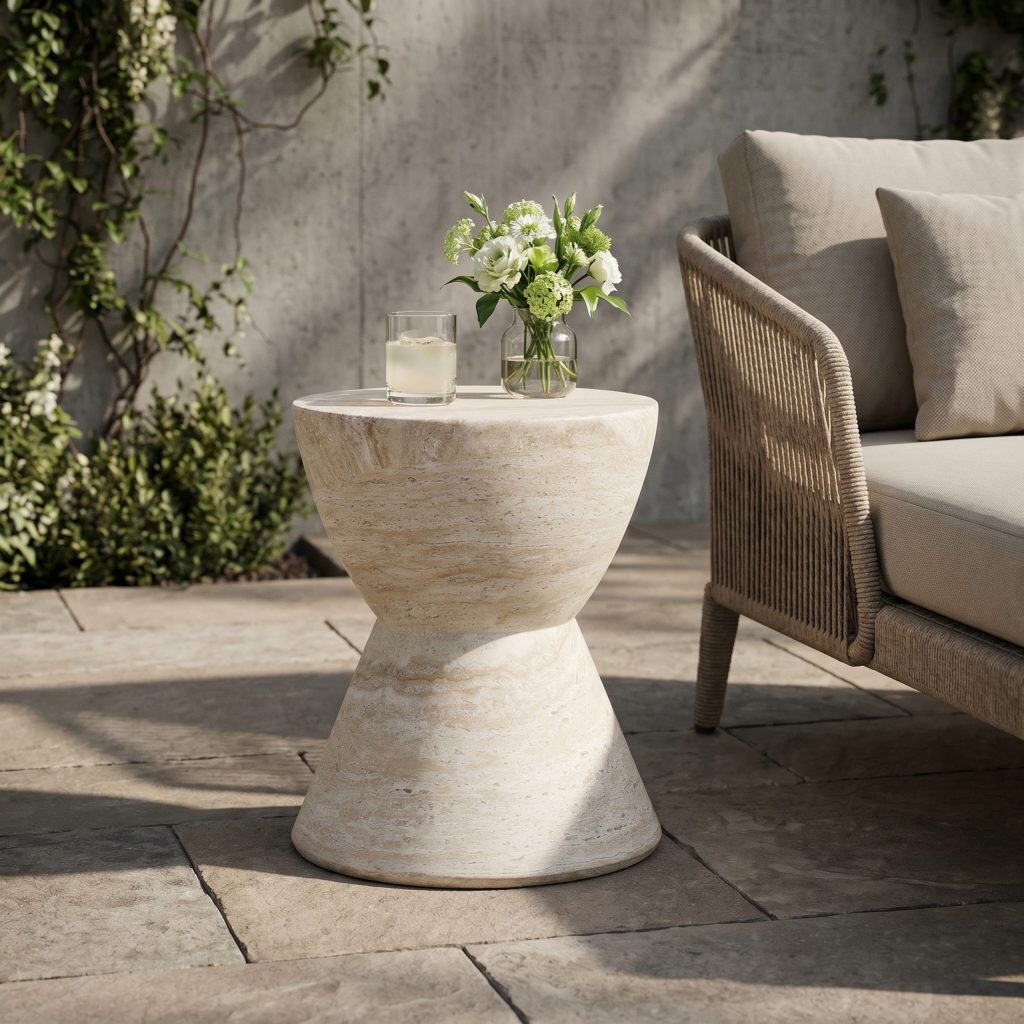
Travertine vs Concrete Side Tables: The Short Answer
You have seen the photo: a travertine drum table beside a linen sofa, soft afternoon light, nothing else in the frame. The travertine vs concrete side table debate usually starts there — and it usually ends at the shipping page, when the crate weighs more than your coffee table.
But here is the part most buying guides skip: the table in that photo is very likely not solid stone. Most travertine-look and concrete-look side tables sold online — including most of what fills your Pinterest board — are fiberglass or MGO composites with an applied stone finish, and that has been true for years. So the real decision is three-way, and the honest version looks like this:
| Feature | Solid travertine | Cast concrete | Fiberglass / MGO composite |
|---|---|---|---|
| Weight | 100+ lbs — two-person move, freight delivery | Heavy — often freight too | 18–33 lbs — one hand, standard parcel |
| Look | Real stone, natural veining and pits | Industrial, matte, monolithic | Layered or smooth applied stone finish |
| Outdoor | Yes, but stains and etches | Yes, can hairline-crack in freeze | MGO: covered outdoor; fiberglass: indoor |
| Maintenance | Seal regularly; acids etch it | Seal; can stain and craze | Wipe clean; no sealing |
| Price | $$$ and up | $$ | $ — $$ |
Solid travertine: the real thing, and what it costs you
Travertine is a natural limestone cut from quarry stone. No two tops are alike — the pitted surface and the layered veining are the whole reason people want it. It also happens to be porous, which is the part the photos do not show.
What that means in daily use:
- Acids etch it. Lemon juice, wine, vinegar, many cleaners. On unsealed travertine a single glass can leave a dull ring that no amount of wiping removes.
- It needs sealing — and resealing. A sealed top is far more forgiving, but the seal wears.
- It is genuinely heavy. A solid stone drum table of any real size runs well over a hundred pounds, needs a two-person move, and usually ships by freight rather than parcel.
- Coasters are not optional. If your household does not reliably use coasters, travertine will keep a record of it.
Buy solid stone only if you want the material itself and you are placing it somewhere stable — a spot you decorate once and do not rearrange every season. For everything else, keep reading.
Cast concrete: honest, industrial, and heavier than it looks
Cast concrete has a different appeal: no veining, no pattern, just a dense matte mass. It reads as architectural rather than decorative, and it pairs unusually well with warm wood and linen because it has no competing grain.
The trade-offs:
- Weight is the issue again. Cast pieces are heavy enough that “I will just move it over there” is rarely a one-person job.
- It is also porous and will take on oil and wine stains unless sealed.
- Hairline crazing happens. Fine surface cracks are common in cast concrete and are usually cosmetic — but if you want a flawless surface, know that going in.
- Freeze-thaw is hard on it outdoors in cold climates.
Fiberglass and MGO: what most “travertine” tables actually are
This is the category the photos rarely mention, and it is where most of the market has quietly gone. Two materials do the heavy lifting:
MGO — magnesium oxide cement — is cast in a mould, which is why it can carry a travertine texture, a smooth concrete matte, or a sculptural twist that would be prohibitively expensive to carve from stone. A water-transfer or hand-applied finish wraps the surface in genuine stone detail: banded veining, sandy pockets, soft undertones. An MGO table in this size weighs 18–19 pounds, moves with one hand, and never asks for a second person.
Fiberglass goes one step lighter and tougher: a fiberglass shell with an applied travertine finish lands around 33 pounds for a full-size drum table, shrugs off knocks, and holds serious weight on top. The trade is climate — fiberglass tables are indoor pieces.
What you gain either way:
- One-hand weight. A base that looks like carved stone and can be repositioned when you rearrange the room. This is the single biggest practical difference.
- Parcel shipping, not freight. No lift-gate delivery appointment, no crate in the driveway.
- No sealing. Wipe it down; that is the maintenance schedule.
Where it is honest to be careful: MGO is well suited to indoor use and covered outdoor spaces. In a climate with hard freeze-thaw cycles, a covered porch will treat it much better than an exposed corner of the yard. And a composite is a composite — from two feet away it reads as stone; from two inches, it does not.
So in the travertine vs concrete side table decision, the composite is the right call when you want the look, the room might change, or the budget is better spent on the form than the quarry.
Five questions that settle it
1. Will you move it?
If the answer is yes — if you rearrange seasonally, or you want a table you can slide over for a laptop — weight is the deciding factor, and it rules out solid stone.
2. Is it going outside?
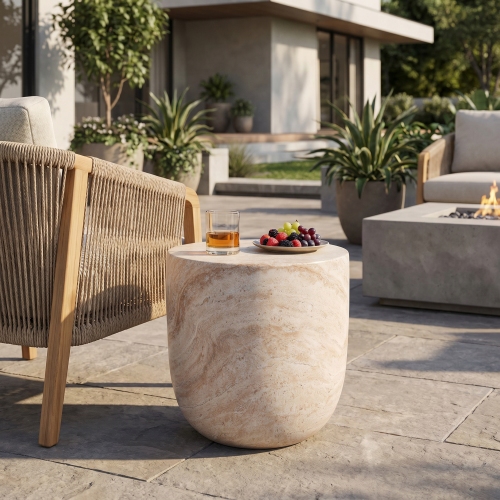
All three can go outdoors, but they age differently. Stone stains and etches, concrete can craze and is vulnerable to freeze, MGO does best under cover, fiberglass stays in. For a fully exposed patio, choose with the climate in mind.
3. How much does the surface matter to you?
If you want genuine stone and you are willing to live with its habits, travertine is irreplaceable — nothing synthetic fully matches it up close. If you want the look in a photo and the feel from arm’s length, a good finish on MGO or fiberglass is very close.
4. What is the room doing?
A beside-the-sofa table gets a drink set on it, a lamp plugged in beside it, and usually gets moved at least once a year. A corner accent table gets looked at. Buy for the harder job.
5. What is the budget really for?
Solid stone commands a real premium for the material. Composite lets you spend on the form instead — a sculptural pedestal or an hourglass base costs a fraction of what it would carved.
Picks by room
Living room — the piece you will actually use
Orivane Travertine Cylinder Side Table — a single clean cylinder with a fiberglass core and an applied travertine finish. At 33 pounds it reads as stone from across the room, holds up to 300 pounds on top, and still lifts with one hand when you want it somewhere else. Indoor use.
Travertine Finish MGO Hourglass Table — if you want the base to be the point. A water-transfer travertine finish over a hollow hourglass form in cast MGO; 19.4 pounds, indoor or covered outdoor.
Covered patio or sunroom
Lightweight Concrete End Table in Light Grey — the same hourglass form cast in MGO with a smooth light-grey matte. 18 pounds means you reposition it for a party, which with cast concrete you simply would not do.
Sculptural Wave-Texture Table — a taller 19.7-inch piece in a magnesium oxide and concrete blend with a ridged surface; works as a plant stand or a garden stool on a covered patio.
Bedroom — beside the bed
The Travertine Cylinder again earns its place here — narrow footprint, no sharp corners, enough top for a lamp and a book.
If you want warmth instead of stone, the solid walnut nightstand is the other honest answer, and it has a drawer.
Small space / apartment
C-Shaped Sofa Table — a slim steel frame that slides under the couch so the base takes no floor space at all.
FAQ
Is a travertine side table real stone?
Sometimes — and the listing does not always make it obvious. A solid travertine table this size runs 100+ pounds and ships freight; a stone-look piece in fiberglass or MGO weighs 18–33 pounds and arrives by parcel. Check the weight and the shipping method before you assume either way.
How heavy is a concrete side table really?
Cast concrete is heavy enough that moving one is usually a two-person task and delivery is often freight rather than parcel. A concrete-look MGO version lands under 20 pounds. If you expect to rearrange the room, that matters more than the material choice looks like it should.
Can MGO side tables go outside?
Yes, and they are considerably easier to place outdoors than stone or cast concrete. A covered porch or sunroom is ideal; in a climate with hard freezes, keep it out of standing water and off fully exposed ground. Fiberglass versions are indoor pieces.
Does travertine stain?
Unsealed, yes — and acidic liquids etch rather than merely stain, leaving a dull mark that cannot be wiped away. Sealing helps substantially and needs repeating over time.
What is MGO?
Magnesium oxide cement — a lightweight cast composite. It can be moulded into forms that would be very expensive to carve from stone, takes surface finishes well, and weighs a fraction of a comparable concrete or stone piece.
Orivane makes premium home essentials in stainless steel, solid wood and cast composite — one quality standard, one honest price. Shop the collection.